
It’s a Leadership Rhythm Problem
In late 2024, we began working with a dealership that, by most traditional measures, was healthy.
- Financially strong.
- Absorption solid.
- Processes documented.
- Reporting clear.
From the outside, it looked stable.
But inside the business, something quieter was happening. Turnover had begun to tick upward and they ended the year at 35%. Engagement felt uneven. Supervisors were carrying more emotional weight than they realized. For one store in particular, the GM couldn’t quite reconcile it.
“I don’t understand,” he told me. “The business is good.” And he was right. The business was good. But the people system wasn’t as stable as the financial system.
The Moment of Clarity
We sat down with a small cross-section of frontline employees: a technician, a parts advisor, a salesperson, and a service advisor. The GM joined the session expecting to hear feedback about tools, workload, or staffing levels.
Instead, the technician said something simple: “I wish someone would check in before something goes wrong.”
A parts associate added, “I never know if I’m doing well until I’m not, and most of the time, its customers who are telling me.”
The salesperson leaned forward and said, “I don’t need more direction. I need more development. I need to know how to better manage my territory.”
There was a long pause.
Afterward, the GM said to me privately, “I realized we weren’t leading. We were reacting.”
That sentence changed the trajectory of the work.
What this dealership didn’t need was a new compensation plan or another engagement survey. They needed to rebuild what I would call their leadership rhythm: the set of consistent habits that shape how leaders show up every day, every week, every month.
In engineering terms, the organization had very little damping. When a small issue emerged, it became a bigger issue because there wasn’t a steady leadership cadence absorbing the shock. People weren’t leaving because the work was hard. They were drifting because leadership felt episodic.
And predictability, not perfection, is what anchors people.
Rebuilding the Leadership Loop
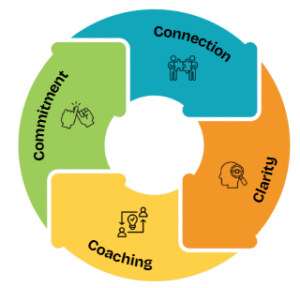
Over the next 90 days, we worked with the GM and his leadership team to rebuild four foundational habits. We refer to this as the Leadership Loop. It is simple, but not simplistic.
The first shift was connection.
Leaders committed to spending intentional time each day checking in with their people, not reviewing metrics, not correcting behavior, but simply connecting. Ten minutes of focused conversation. Some questions to ask include:
- How are things going?
- What’s frustrating?
- What’s working?
- Where are you stuck?
Within weeks, something subtle changed. Small problems surfaced earlier. Supervisors felt less blindsided. Employees felt less isolated. Trust began to grow. Not because of a grand initiative, but because of consistent presence.
The second shift was clarity.
Every Monday morning, leaders began holding short huddles with their teams, specifically hosted by the parts, service, and sales managers, centered on one question:
What’s most important this week?
No slides. No dashboards. Just alignment.
What are the top priorities? What does success look like? Where might we get distracted?
Employees began to say they finally understood how their daily work connected to the larger plan. Confusion decreased. Energy increased. Leaders stopped managing activity and started reinforcing direction. Clarity reduced noise, and when noise decreases, stress decreases.
The third shift was coaching.
Instead of limiting conversations to performance corrections or annual reviews, leaders began holding monthly development discussions. They asked employees what they wanted to improve, what barriers they were encountering, and how leadership could help remove friction.
One long-time technician said, “I’ve been here eight years and no one has ever asked me what I want to get better at.”
That comment revealed more about retention than any exit interview ever could.
Coaching moved from being a corrective tool to a growth mechanism. And when people see a path forward, they’re far less likely to look elsewhere.
The final shift was commitment.
Each quarter, leaders and employees agreed on one development commitment. Something tangible and shared. Not a laundry list of goals. One focused promise. Progress was reviewed consistently and accountability became a partnership rather than a pressure tactic.
Over time, ownership increased. Conversations became easier. Performance discussions became less emotional because they were built on an existing relationship of trust and clarity.
What Changed — and What Didn’t
Within three months, the dealership began to feel different.
Trust increased. Tension softened. Supervisors reported feeling more supported rather than overwhelmed. Voluntary turnover slowed.
What’s important is what didn’t change.
- They didn’t overhaul compensation.
- They didn’t restructure the organization.
- They didn’t launch a culture campaign.
They changed their leadership habits.
The GM summed it up well: “We didn’t change our people. We changed how we showed up for them.”
Why This Matters More Than Most Dealers Think
At this point in the story, some dealer principals will quietly say:
“Turnover is just part of the business.”
“Technicians are hard to keep.”
“Salespeople move around.”
I want to challenge that thinking.
Turnover is not a line item. It is a systems failure signal.
Most research, and our field experience supports this, estimates that the real cost of losing a solid employee is roughly three times their annual salary when you factor in recruiting, onboarding, training, lost productivity, customer disruption, supervisory time, and cultural drag.
For a $90,000 technician, that’s not $90,000.
It’s closer to $270,000.
And that doesn’t include the hidden cost of:
- Delayed work orders
- Strained customer relationships
- Burned-out teammates covering the gap
- Supervisors spending time hiring instead of leading
Now multiply that by two or three departures per year.
Suddenly, retention isn’t soft. It’s strategic.
Paradoxically, what erodes profitability even faster than turnover is how leaders rationalize it.
“She wasn’t that committed anyway.”
“He just wasn’t a culture fit.”
“They weren’t that strong.”
Sometimes that’s true. Often, it’s convenient.
In many cases, the departure is less about the individual and more about the environment they experienced: unclear expectations, inconsistent feedback, little development, reactive leadership.
When leaders rationalize departures, they rob themselves of the opportunity to strengthen the system.
In the dealership we worked with, the GM said something that stuck with me:
“I used to think turnover was just the market. Now I see it was partially our rhythm.”
That’s an important shift. Because when you stop rationalizing departures, you start diagnosing patterns.
And when you diagnose patterns, you can redesign habits.
The Framework Behind the Story
When we talk about People Stability inside the DOER framework, we are not talking about morale. We are talking about system reliability.
A dealership can have strong financial controls and documented processes, but if leadership habits are inconsistent, the people system becomes volatile. Volatility shows up as turnover, disengagement, burnout, or quiet withdrawal.
The Leadership Loop works because it introduces rhythm:
- Daily connection builds trust.
- Weekly clarity aligns effort.
- Monthly coaching grows capability.
- Quarterly commitments strengthen accountability.
Together, these rhythms create organizational capacitance; the ability to absorb disruption without overreacting.
Retention, in this sense, is not a perk strategy. It is a stability system.
In a market where skilled technicians, strong service advisors, and capable sales professionals are scarce, leadership consistency may be one of the few sustainable advantages left.
People do not stay because the work is easy. They stay because leadership is predictable, developmental, and steady.
And that is not built with a strategy deck. It is built with habits that compound over time.
About the Author
Luke Sheppard is Principal of Sheppard & Company, a strategic consultancy located in Ottawa, Canada, which focuses on management consulting and business advisory services for the heavy equipment industry. Luke’s unique ability to focus on what’s most important by filtering through the noise, solving business problems using engineering methods and driving results with practical tools and solutions differentiates him as a leader in the industry. His work reflects the premise that diverse and engaged teams drive exceptional results and helps entrepreneurs and managers build and lead high-performing teams.