
Are you need IT Support Engineer? Free Consultant

The Hidden Cost of Disorder

  • November 12, 2026

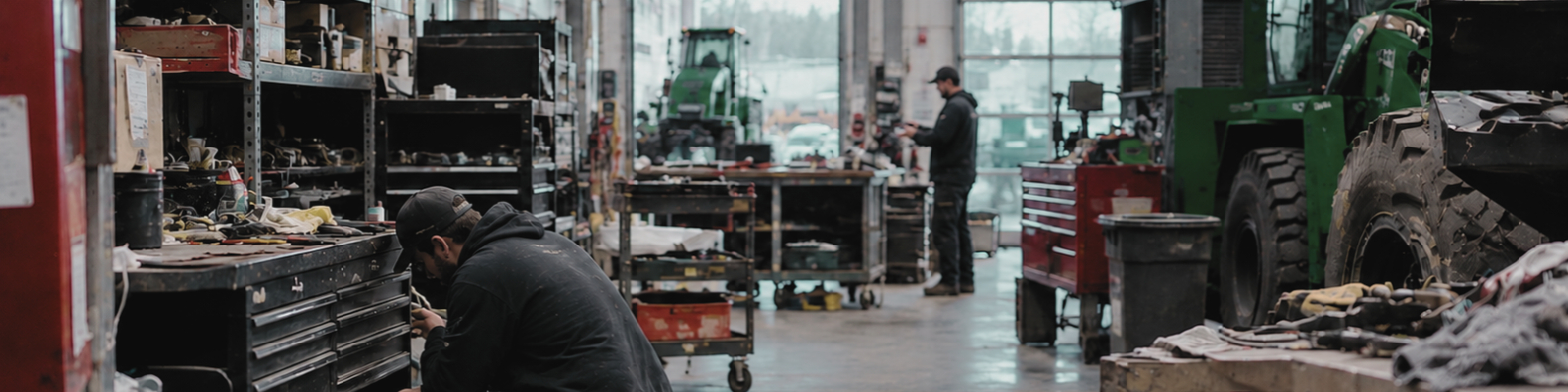
Two technicians searching for tools and parts in a cluttered heavy equipment service workshop, highlighting the importance of operational excellence for dealerships.

Why Operational Excellence for Dealerships Begins with Organization

Author: Matt Wills, Partner at Sheppard & Company

When I say disorder has a hidden cost, people don’t always believe me right away.   

As I start a 5S engagement, I often get pushback. It starts subtly: an eye roll, crossed arms. Then it becomes verbal: questions, debate, and reasons why an area can’t be cleaned up.  

It usually sounds like this: 

“It’s not that bad.” 

“We’ve done it this way for years and the sky hasn’t fallen.” 

“We make money.” 

“Customers don’t complain.” 

“We don’t have the time, and it costs too much.” 

“You don’t understand. We’re really busy.” 

That’s fair. Too often, discussions about operational excellence for dealerships get reduced to generalities: wasted time, lost parts, frustrated staff and safety risks.

Generalities are easy to nod along to and just as easy to dismiss. So let’s put some numbers to it and make the hidden cost a little less hidden. 

The four leaks and what they cost 

Disorder has a real cost. It leaks in many areas; I would like to narrow it down to four places: obvious hidden leaks, reputation, talent, and your brand. 

 The figures below are deliberately conservative. They assume a mid-sized dealership with 30 employees across sales, parts, service and administration, including 5 technicians, a $150 door labour rate and 2,000 available working hours per person a year (250 days). Lost technician time is counted at a 65% gross margin and lost parts sales at 35% margin. Swap in your own numbers if these seem too aggressive or conservative. 

1. The obvious hidden leaks 

Yes, I know “obvious hidden leaks” is an oxymoron. Bear with me. Disorder rarely shows up as a line on the financial statement. It hides inside other numbers. 

  • Search time. Technicians hunt for tools, parts and paperwork instead of turning wrenches. Every minute searching is a minute not billed. And it isn’t just technicians. Parts, sales and admin staff lose valuable time too, hunting for keys, units, files and paperwork. That time is a bit harder to quantify, but it’s just as real. 
  • Safety incidents. Clutter on floors and benches causes slips, trips and damaged equipment. Every incident costs productivity, in any department, and a lost-time injury costs far more. 
Leak Assumption Annual Cost
Technician search time 5 techs, 30 minutes a day (125 hours a year each), at 65% margin $61,000
Other staff search time 10 people, 15 minutes a day, at $40 an hour $25,000
Safety 2 minor incidents ($5,000 each) and 1 lost-time injury ($10,000) $20,000
Obvious hidden leaks total $106,000

↔ Swipe to view all columns

2. Reputation 

Customers may not complain, but they notice. A cluttered service counter, a messy shop seen through the window or a unit returned with a greasy seat all send a message: if they can’t organize their shop, how well will they look after my machine? Most customers don’t argue. They simply buy somewhere else next time. The ones who stay pay less. When customers don’t trust what they see, they question every invoice, ask for hours to come off, and expect goodwill. Your door rate says $150. Your reputation decides what you collect. The same goes in the field. A messy, disorganized service truck pulling into a customer’s yard says you’re not worth top dollar, and you can’t command a premium rate if you don’t look the part. That’s before counting the second trip when the truck doesn’t have the tools or parts for the job. 

Leak Assumption Annual Cost
Shop labour rate 10% less collected on a $150 rate ($15 an hour), 6,000 shop hours (3 shop techs at 2,000 hours) $90,000
Field labour rate 10% less on a $175 rate ($17.50 an hour), 4,000 field hours (2 field techs at 2,000 hours) $70,000
Reputation total $160,000

↔ Swipe to view all columns

3. Talent 

Good technicians, parts people, service advisors and salespeople all have options. A disorganized workplace tells them the dealership doesn’t value their time or their safety. It makes recruiting harder, and it pushes your best people toward the competitor down the road. In a tight labour market, a well maintained dealership that has adopted 5S is a selling point. The biggest talent cost comes when a good hire leaves after you’ve invested in them. Each replacement includes hiring, the empty seat, ramp-up, and training. 

Disorder won’t cause every departure. But it’s one more reason good people leave, and one more reason good candidates say no. If it drives even one departure in each role, here’s what that costs: 

Role Assumption Cost to replace one
Technician 1 month empty and 3 months at half speed ($20,000 a month at 65% margin), plus $10,000 to hire $42,500
Salesperson 3 months empty in a $2.5M territory, at 10% margin $62,500
Parts person $100,000 in sales, half covered by others, at 35% margin (not tenable forever) $17,500
Administration Errors, overtime and training time $10,000
Talent total One of each lost in a year $132,500

↔ Swipe to view all columns

4. Brand 

Your dealership carries the manufacturer’s brand and your own name on the sign. Both promise quality and reliability. When the facility doesn’t match that promise, customers notice. A disorganized shop and a cluttered yard show badly. A dirty service truck pulling into a customer’s yard makes them question why they’re paying your rates. When customers don’t see the value, you end up in the business of justifying your price instead of educating them on your value. That’s a much harder conversation, and it shows up in your margins. In the end, customers see you one of two ways: as the low-cost option or as the value provider. People pay for value. They fight on price when they think you’re a cheap brand. Brand is the hardest leak to measure, so this is the biggest assumption in the article: that how you look costs you 1 point of operating margin. 

Leak Assumption Annual Cost
Lost operating margin 1% of operating margin on $30M in annual revenue $300,000
Brand total $300,000

↔ Swipe to view all columns

Answering the objections 

Let’s go back to the common comments I hear at the start of an engagement. Each objection has a fair point behind it, and each misses the cost. 

What we hear What it misses
"It's not that bad." Disorder becomes invisible to the people who work in it every day. Customers and new hires still see it.
"The sky hasn't fallen." The cost leaks slowly, as lost hours, lost parts, lost people and lost customers. It never arrives as one event.
"We make money." The question is how much more you would make without the leaks.
"Customers don't complain." Most customers don't complain. They quietly take their next purchase elsewhere.
"We don't have time, and it costs too much." Say 5S costs you $50,000. Disorder costs about fourteen times that, every year.
"We're really busy." Busy shops lose the most to searching, so they have the most to gain.

↔ Swipe to view all columns

Where to start 

You don’t need to sell 5S as a philosophy. Start by making the cost visible. 

  1. Walk the floor with fresh eyes. Take a customer’s route, then a new hire’s. Note what each would see. 
  2. Measure one leak. Track search time or safety incidents for two weeks. 
  3. Put a dollar figure on it. Use your own labour rate and parts data. 
  4. Share the number with the team. Let them see what disorder costs them, not just the dealership. 
  5. Pilot one area. Pick a bay, the parts counter or the wash bay, and show the before and after. 
Adding it up 

Add all four leaks together and the conservative cost for a mid-sized dealership is about $700,000 a year. That’s usually enough to end the debate. 

Leak Conservative Annual Cost
Obvious hidden leaks $106,000
Reputation $160,000
Talent $132,500
Brand $300,000
Total $698,500

Yes, 5S has a cost too 

To be fair, 5S isn’t free. It takes time, some money and, most of all, discipline. 

Let’s assume it costs you $50,000 to get started. So what? If 5S recovers even a quarter of the $700,000, that’s about $175,000 a year back in your business. You’d earn back the $50,000 in less than four months, and keep earning after that. 

The real cost isn’t the labels or the shelving. It’s the discipline to keep it going after the first push. That’s where most 5S efforts stall, and it’s why leadership matters so much. 

Order isn’t about looking tidy. It’s about protecting your margin, your reputation, your people and your brand. Disorder is already costing you, likely hundreds of thousands of dollars a year. The only question is whether you choose to see it. 

What separates the engagements that stick 

When I look back at the 5S engagements that succeeded, two things were always present: strong leadership and a good process. Those are table stakes. 

The engagements that went furthest had something more. The team saw the hidden cost of disorder and how it affected the dealership, their people and their customers. Once people see the cost, 5S stops being a cleanup exercise and becomes a business decision.