
Why Leadership Development for Dealers Drives Better Execution
Author: Chris Holmes, Senior Executive Coach at Sheppard & Company
I’ve been fortunate throughout my career to work with some very successful leaders and entrepreneurs, both within and outside the heavy equipment business. One thing I’ve consistently observed is that what separates high-performing leaders from average performers isn’t necessarily their ability to develop great strategies. It’s their ability to execute.
Most dealer principals I work with have a reasonably good understanding of where their business needs to improve. They know which departments are underperforming, where customer expectations aren’t being met, and which members of their leadership team need further development. They generally have some good ideas about what needs to change.
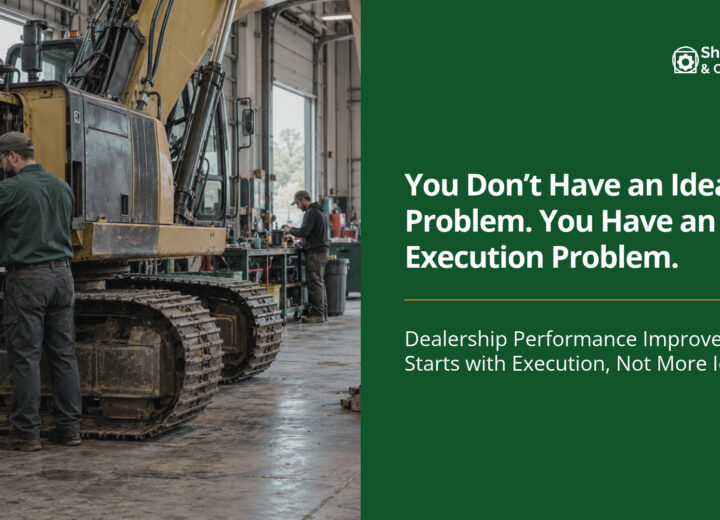
The challenge is getting those ideas off the planning table and into the everyday activities of the dealership.
The executive coaching I do today revolves around helping dealer principals develop the strategies and tactics needed to build a successful business. More importantly, it’s about helping them develop the leadership disciplines required to follow through. Simply put, the “what” and the “how” of driving improvement.
When I begin a new leadership coaching engagement, I often review the 15 Leadership Building Blocks I’ve developed from lessons learned over more than 40 years in business. These are principles I’ve picked up from some very successful leaders and entrepreneurs, along with my own experiences operating dealerships. While each addresses a different element of leadership, they all come back to one critical capability: execution.
Good Strategies Don’t Guarantee Good Results
I recently wrapped up several dealer principal coaching engagements that resulted in some meaningful changes to their businesses. We worked on organizational structure, leadership development and establishing a clearer direction for long-term success.
Throughout these engagements, we maintained our focus on what I call the 3Wins: the customer as Win #1, the dealership as Win #2, and the employees as Win #3. These three outcomes are closely connected and happen in parallel. Successful leaders understand that sustainable improvement needs to benefit all three.
Looking back, what impressed me most wasn’t necessarily the strategies we developed. It was the commitment these leaders made to executing them.
I’ve seen plenty of good business plans over my career. Some were exceptionally well thought out, supported by sound financial analysis and developed with the best intentions. Unfortunately, many never made much of a difference to the business.
Why? Because the discipline to execute wasn’t there.
The road to high performance is littered with strategies and business plans that never changed how people worked. At the end of the day, it’s the ability to translate a strategy into clear actions, engage those responsible for delivering them, and follow up consistently that produces results.
This is where leaders need to lead.
Don’t Let Perfect Get in the Way of Progress
One of the challenges I’ve encountered throughout my career is the tendency to wait for more information before making a decision.
“We need more data before we can move forward.”
I’ve heard that more times than I can count.
Don’t misunderstand me. I’m a strong believer in making informed decisions, particularly when the financial or operational consequences are significant. However, I’ve also watched dealerships miss opportunities because their leaders wanted 90% or greater certainty before committing to a course of action.
In many situations, 70% certainty, combined with the experience of the right people, is enough to get moving.
Think about a service operations challenge. If you’ve involved your Branch Operations Manager, General Service Manager, Branch Service Manager, Shop Foreman and PSSR in understanding the problem and developing a solution, chances are you’ve got a pretty good foundation for making a decision.
Those individuals understand the business. They’re working with customers, technicians and processes every day. More importantly, when they’re involved in developing the solution, they’re considerably more likely to take ownership of making it work.
Will every decision be perfect? Of course not. But I’ve learned that making a sound decision, executing it and adjusting along the way is often far more productive than waiting for information that may never arrive.
Successful leaders know when they’ve heard enough to make a decision. Then they get moving.
The Top 5/Top 3 Discipline
During the latter part of my dealership career, I developed a process that helped me and my leadership teams stay focused on what mattered most. I call it the Top 5/Top 3.
The principle is straightforward.
Identify the Top 5 strategies that will have the greatest impact on the performance of your business. These represent the “what” you need to accomplish.
Then identify the Top 3 tactics, the specific actions you and your team will undertake over the next 90 days to move those priorities forward. These represent the “how.”
It sounds simple, and it is. But that simplicity is what makes the process effective.
Too often, dealership leadership teams have so many initiatives underway that it’s difficult to determine which ones really matter. Everyone is busy, meetings are taking place, and progress reports are being prepared. Yet six months later, the business hasn’t materially improved.
One of the first things I encourage dealer principals to consider is whether they’ve given their people too many priorities. Every new initiative requires time, resources and management attention. If everything is important, chances are nothing is getting the attention it deserves.
The Top 5/Top 3 process requires leaders to make choices, establish clear expectations and commit to following through.
I’ve recently been working with a leader using this discipline. We began with the leadership building blocks, then moved into establishing his Top 5/Top 3. What I’ve been particularly encouraged by is his willingness to start documenting commitments and taking action between our coaching sessions rather than waiting for our next conversation. His senior leader has already noticed a difference.
An equally important part of the process is ensuring his priorities are aligned with those of the business. The intent is that, once our coaching engagement is completed, he and his senior leader can continue using the same process to manage priorities, measure progress and support his development.
That’s what I like about this approach. It isn’t intended to be another management exercise that disappears after a few months. It’s a living business planning and execution process that helps leaders stay focused on what’s important.
Execution Requires More Than Accountability
One tool I found particularly effective when I was running dealerships was the project charter.
When we identified an important strategy, we’d involve the people who would be responsible for executing it in developing a clearly defined project. We’d establish the outcomes we expected, the specific performance thresholds we needed to achieve, who was responsible and when the work needed to be completed.
We’d also establish communication plans and project scorecards to measure progress.
Very simple. Very effective.
But there’s another lesson I’ve learned, particularly through executive coaching, that I believe is worth emphasizing.
When someone isn’t executing, the answer isn’t always to apply more pressure.
Sometimes the expectations aren’t clear. Sometimes the individual doesn’t have the skills or experience needed to deliver. Occasionally, we’ve given someone so many competing responsibilities that they simply don’t have the capacity to complete what we’ve asked of them.
And yes, sometimes the problem is that the individual hasn’t made the commitment required.
These are different challenges, and they require different leadership approaches.
A good dealer principal understands the difference. They know when to coach, when to provide additional support, when to remove obstacles and when it’s time to have a more direct accountability conversation.
I’ve always believed we’re working in a relatively simple business. Where it gets complicated is when we fail to engage our people, establish clear expectations and follow up on the activities that matter most.
One of the most important leadership lessons I learned from a mentor many years ago was this:
Expect to be disappointed if your people don’t know what to expect.
That lesson has served me well throughout my career.
It’s difficult to hold someone accountable for an outcome when they don’t clearly understand what success looks like, how their performance will be measured or what authority they have to make decisions.
This is where effective communication, leadership development and execution all come together.
The Dealer Principal Sets the Pace
When I was in the dealership business, I thrived on building strategies and tactics with my teams, establishing expectations, and maintaining a consistent cadence of follow-up.
We used dashboards, scorecards, and regular in-person progress meetings. Everyone knew what we were trying to accomplish, who was responsible, and how we were progressing.
There were no surprises.
If an initiative was falling behind, we addressed it. If someone needed help, we worked through the problem. If expectations weren’t met, we would have the necessary conversations.
The important point is that we didn’t wait until the end of the quarter to discover something wasn’t working.
As a dealer principal, you set the pace. If you approach execution casually, chances are your leadership team will do the same. If you establish clear priorities, demonstrate your own commitment and consistently follow up, people begin to understand that execution is part of how the dealership operates.
But there’s one more element that I believe separates good dealerships from truly high-performing businesses.
The improvements need to stick.
Completing a project is one thing. Changing how your people work is something else entirely.
If you’ve established a new process for managing work in progress, for example, does the service manager continue reviewing it consistently after the initial project is completed? Do the service advisors understand their responsibilities? Are problems being identified and addressed before they affect the customer? And does the process continue to work when the dealer principal or general manager isn’t there to follow up?
That’s where you begin to see the difference between completing an initiative and developing a high-performance culture.
The goal isn’t to have your people depend on you to keep things moving. It’s to develop leaders who understand what’s expected, have the confidence and capability to make decisions, and take personal ownership of results.
That requires discipline, but it also requires investment in your people.
Crossing the Finish Line
Over more than four decades in this business, I’ve learned that successful dealer principals aren’t necessarily the ones with the most sophisticated strategies or the greatest number of initiatives underway.
They’re the ones who know what matters, engage their people in determining how to get there, and maintain the focus needed to finish what they start.
They also understand that execution doesn’t end when a project is completed. The real return comes when improvements become part of the everyday operations and culture of the dealership.
As you look at your own business, consider the strategies and initiatives you’ve introduced over the past year.
How many have produced measurable improvements? How many have changed the way your people work? And how many are still waiting for someone to follow through?
More importantly, if you stepped away from the business for a few weeks, would those improvements continue?
If you believe you’ve got the right strategies in place but aren’t seeing the progress you expected, I’d encourage you to take a hard look at your execution process and your own approach to leading it.
Chances are that’s where you’ll find the roadblocks.
At the end of the day, developing a good strategy is important. Building a leadership team capable of consistently executing it is what gets you across the finish line.