

From 5S Projects to Operational Excellence for Dealerships
Author: Andrew Dewar, Senior Operations Manager at Sheppard & Company
I started my career as an industrial engineer and continuous improvement facilitator. I was that guy who would show up on the shop floor with my stopwatch, chasing people down to get a time study done. As you can imagine, I didn’t make a lot of friends that way!
However, spending so much time observing people work taught me an important lesson. Most people are already working hard. The real opportunity lies in creating a system that helps people work more effectively and ensures that improvements are sustained. This is especially true when it comes to 5S.
Why 5S Initiatives Struggle
Implementing improvements and sustaining them are two very different things. Unfortunately, 5S is often introduced as a project that has a defined start and end date. Enthusiasm is high at the beginning, the entire team is participating, and a long list of visible improvements is celebrated. However, in a month or two, the same enthusiasm that was there to make the improvements often disappears when it’s time to sustain the improvements.
What a 5S System Looks Like
What separates a 5S project from an effective 5S system is the emphasis placed on Standardize and Sustain. Sort, Shine and Set-In-Order are the flashy steps that produce immediate and visible results, but it’s Standardize and Sustain that establish the system needed to maintain and build upon those early wins. It’s kind of like getting the oil changed on your car. Not very exciting, but neglecting it could leave you at the side of the road, waiting for a tow.
Does your organization view 5S as a project or a system? Let’s dig into that a bit more with a few examples.
| 5S as a Project | 5S as a System | |
|---|---|---|
| Standardize | Sustain | |
| Organizing a toolroom | Creating a check-in/check-out system for shared tools | Monitoring compliance and addressing missing tools |
| Cleaning the shop | Defining cleaning routines and responsibilities | Verifying cleaning routines are consistently followed |
| Labelling parts racking | Establishing inventory location and labelling standards | Routinely auditing locations and correcting any discrepancies |
| Conducting occasional 5S audits | Defining audit criteria, frequency and ownership | Conducting audits, capturing and closing corrective actions |
| Providing a one-time 5S training course for employees | Developing standard 5S training materials | Building 5S training into new employee orientation and delivering refresher courses to all employees |
↔ Swipe to view all columns
Breaking the Cycle of Disorganization
In his post “The Hidden Cost of Disorder”, Matt Wills, Partner at Sheppard & Company, points out that dealership employees often tell us they just don’t have time for 5S. Back in my factory days, I felt exactly the same way when I was first asked to 5S my work area. To me, it looked like one more thing piled onto an already busy schedule.
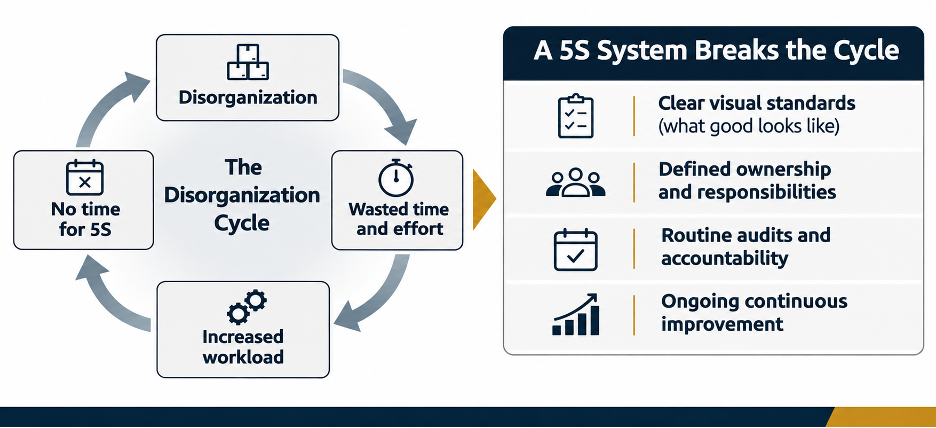
But what I didn’t realize was that I was stuck in a cycle of disorganization. What’s that mean? Well, without a proper 5S system in place, people will find themselves spending a large part of their day compensating for disorganization. Time spent searching for tools, locating parts or finding paper for the office printer adds to an already busy day, leaving less time to address the disorganization in the first place.
How to Know if Your 5S System is Working
Audit scores and before-and-after pictures are great if you want to understand the progress of your 5S program, but one of the best ways to determine how effectively your 5S system is working is through regular “go-and-see” walks (also known as Gemba walks). This means going to where the work is performed and rather than focusing on how a workplace looks, observing how people work and engaging them in conversation. During these walks, consider these questions:
- Are work areas maintained to the same standard no matter who is working?
- Are employees following standards without being reminded?
- When standards aren’t met, are the underlying issues identified and tackled?
- Have improvements been sustained six months after being implemented?
- Are employees actively engaged in identifying new opportunities for improvement?
- Have 5S routines become part of everyday operations?
- Is the dealership seeing measurable improvements in safety, productivity and efficiency?
Another simple test is to look at what happens when an important visitor is coming to the dealership. I’m sure many of us can relate to the frantic cleanup that happens when we know an OEM representative, a major customer or the company president is coming to visit. Suddenly, we’re trying to squeeze additional work into an already busy schedule—cleaning the shop, tidying up the yard, and organizing our own work areas. The amount of extra effort required to prepare for these visits is a pretty good indicator of how well your 5S system is working.
From Extraordinary Effort to Everyday Practice
The ultimate measure of a successful 5S system isn’t how organized a workplace becomes, but how well those improvements are sustained and built upon without excessive effort or constant management intervention.
The missing ingredient isn’t effort. It’s a system.