
Four Books for Building the Dealership of the Future
Author: Luke Sheppard, Principal of Sheppard and Company
In our October DOER Digest newsletter, I explored a tension growing more visible in dealerships: the need to become more disciplined without becoming less human.
I’m seeing dealership leaders introduce stronger processes, clearer accountability, and, increasingly, artificial intelligence. Many of these changes are uncomfortable but necessary. Modernization is coming either way. For leaders focused on organizational development, what matters is the kind of dealership you end up with on the other side.
It is tempting to treat the current technological moment as unprecedented, and in some respects it is. AI can work with language, synthesize information, and support decisions in ways earlier machines could not. It is also spreading far faster than the steam engine, electrification, or the first business computers.
Still, we have been here before. Earlier technological revolutions also promised greater productivity and a better standard of living. They eventually delivered much of it, but the benefits were rarely automatic and seldom evenly shared.
The early Industrial Revolution dramatically increased production, yet the incomes of many workers stayed flat for decades. Power looms multiplied textile output while driving down the wages of skilled weavers. The machinery was productive. Whether it produced broadly shared progress was another matter.
Electrification taught a different lesson. Factories did not get the full benefit by swapping a steam engine for an electric motor. They had to rethink where equipment sat, how materials moved, and how the work itself was organized. Computers followed the same path, sitting in offices for decades before their productivity effects showed up in the numbers.
If you’ve ever implemented a new dealer business system, you’ve probably seen this. Old habits usually migrate quite comfortably into new software.
AI won’t follow these patterns exactly. The Industrial Revolution mechanized physical work, and computers automated calculation. AI is reaching into communication, analysis, and judgment, which is the work managers and professionals have traditionally been paid for. But the question you face as a leader hasn’t changed much: will technology be designed around people, or will people be reorganized around the technology?
Four books have helped me think about that question and what it means for your dealership.
Meditations by Marcus Aurelius

A book written by a Roman emperor two thousand years ago is an odd place to start a discussion about AI in dealerships. But technology doesn’t remove the need for leadership. If anything, it raises the stakes.
Marcus Aurelius wrote Meditations as private notes to himself on self-command, humility, and keeping perspective when things go badly. It was never meant to be a management book, which may explain why it contains more useful management advice than most books that were.
For you, the relevance is direct. Your dealership’s culture is shaped disproportionately by how you and your senior leaders behave. What you consistently notice, tolerate, and reward becomes the real operating system, regardless of what the policy manual says.
It’s hard to build accountability while avoiding difficult conversations. It’s harder still to ask managers to follow a process while making exceptions, and most of us have made that exception at least once. And a leadership team that reshuffles priorities every time a new fire starts shouldn’t be surprised when execution looks the same way.
AI can help you prepare for a difficult conversation, summarize the facts, or spot a pattern. It won’t give you the nerve to act on any of it, and it won’t carry the consequences. That part is still yours.
Shop Class as Soulcraft by Matthew B. Crawford
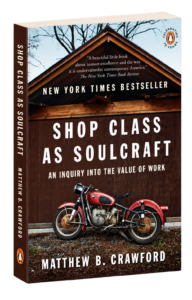
Crawford is a philosopher who also repairs motorcycles. In Shop Class as Soulcraft, he makes the case for the intelligence and judgment in skilled manual work, and for the satisfaction that comes with it. That argument lands squarely in an industry built on technicians, parts professionals, and equipment specialists who solve physical problems in conditions that rarely match the manual.
You measure labor efficiency, utilization, recovery, and work-in-process, and you should. But those numbers capture only part of what makes your experienced technicians valuable. They miss the diagnostic instinct. They miss the ability to reassure a customer standing beside a machine that needs to be working by morning.
A few weeks ago, I watched a technician rapidly move between repairing a chainsaw engine, diagnosing a lawnmower no start, and interrogating an engine head gasket leak in a skid steer. All while talking to a customer in the field who was struggling to fix their AC system in the scorching heat of a Southwest summer. It’s hard to see where this shows up on a productivity or efficiency report.
The Industrial Revolution separated many workers from the finished product of their labor, and scientific management later broke work into ever smaller standardized tasks. Both delivered real gains. Both also showed what happens when efficiency is pursued with little regard for craft.
None of this argues against standardization. Your technicians shouldn’t have to reinvent how work orders are opened or how parts are staged. Poor process doesn’t protect craftsmanship; it eats the time and attention craftsmanship needs.
The real question for you is what to standardize and what to leave to professional judgment. Good process removes avoidable friction and gives skilled people better information and more time on the work that needs them. Bad process has a technician satisfying the system while the customer and the machine wait.
The Human Use of Human Beings by Norbert Wiener
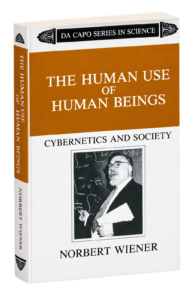
Norbert Wiener helped found cybernetics, the study of communication, control, and feedback in machines and living systems. He published The Human Use of Human Beings in 1950, just as computers and automation were moving out of wartime research. The title alone is a warning worth keeping in mind.
Wiener saw that machines could extend what people are able to do and spare them repetitive work. He also saw that the same systems could diminish people if efficiency became the only goal. Many of today’s arguments about AI are ones he was already having seventy-five years ago.
Your dealership is already a cybernetic organization, even if no one calls it that. Telematics send signals from your machines in the field. Dashboards turn activity into information. Managers respond, employees adjust, and the system feeds back again. AI will speed that loop up by finding patterns, drafting responses, and recommending action.
That can make your dealership more proactive. It can also create the illusion that better information means better management. A dashboard will show you an aging work order, but somebody still must have the conversation that clears it. An algorithm can flag a customer who’s drifting away. Getting that customer back is still a person’s job.
I work with many dealerships and dealer principals who have near-limitless access to data, with elaborate dashboards using the latest analytics software. Yet their performance continues to lag. Insights are useless if human behavior is the limiting factor.
The test for any system you bring in is whether it makes your people more capable. Making them easier to watch is a much lower bar.
Power and Progress by Daron Acemoglu and Simon Johnson
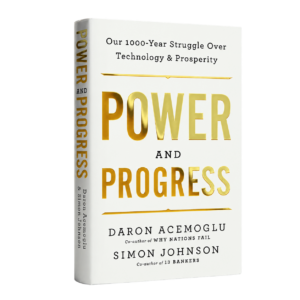
Power and Progress takes the longest view of the four. Acemoglu and Johnson look at a thousand years of technological change and challenge the assumption that innovation naturally creates shared prosperity. They aren’t anti-technology. Their point is that the outcome depends on who shapes the technology, how it’s deployed, and whether it builds new capabilities for people or simply removes them from the process.
That matters as you decide how to use AI. The same tools can centralize every decision at head office or give your branch managers better information to decide for themselves. They can reduce employees to scripted interactions or take administration off their plates, so they spend more time with customers. They can eliminate entry-level work or help newer employees learn faster from what the organization already knows.
Which of those happens is a design choice, and it belongs to you.
So, the question for you is bigger than “Where can we use AI?” It’s “What kind of dealership are we trying to build, and where can AI help us get there?” The first question gets you a collection of tools. The second gets you a strategy.
Looking at the Dealership You Have and the One You Need
Taken together, these books suggest looking at your dealership through two lenses.
The first is your dealership as it runs today. Where does your business still depend on tribal knowledge and heroic effort? Where are expectations fuzzy or accountability uneven? Where do systems create extra work because the underlying process was never settled? Where are your best people spending their time compensating for organizational weakness?
The second is the dealership you’ll need. What must become more consistent across locations? Which decisions should move closer to the customer? What knowledge has to be captured before your experienced people retire? Where can AI sharpen judgment or speed up communication? And which relationships and decisions should stay deliberately human?
That’s where the DOER Diagnostic fits. It isn’t meant to produce another scorecard that management admires for a week before going back to firefighting. It gives an honest view of where your dealership stands today across leadership, management systems, processes, customer experience, and business performance. From there, you and your leadership team can make deliberate choices about the operating system your dealership needs next.
The goal isn’t the most automated dealership or the thickest binder of SOPs. It’s a place where good people can do good work consistently, with disciplined leadership, reliable processes, and useful technology behind them, and enough room left for judgment.
More disciplined. No less human.